Monday, September 8, 2014

God help me, I'm about to teach about "protists" in zoology! Molecular methods have taught us that "protists" is a term without meaning in the evolutionary scheme of things, but the term won't die since it's a "convenient" way to talk about everything that isn't a plant, an animal or a fungus. But it leads to all kinds of confusion so I personally doubt the educational value of such a term.

For example, the text I'm using insists on calling Opisthokonts a "phylum" (opisthokonts include animals and fungi) and then turns around and calls the animals a "kingdom"! You can't have a "kingdom" as a group contained within a "phylum". Furthermore, in a couple of places unicellular critters with no close connection to animals are called "animals". There's something about zoologists that doesn't let them give up critters that used to be thought of as "animal-like", but clearly aren't. Maybe it's the collection mentality.

Speaking of the collection mentality, a group I'm associated with is arguing about moves to have the Monarch butterfly declared a threatened species. Beyond the difficulty of determining what "threatened" means, I'm sure part of the disagreement stems from collectors who fear another encroachment on their ability to collect. Already in many European countries one cannot collect moths and butterflies without some sort of permit from the government, and those permits are often quite difficult to obtain.

I find myself torn on this issue. I applaud the drive to preserve nature, and I think collectors can be unconscious about the impact of their activities, but really? Banning a kid from picking up a net and collecting some common butterflies or moths helps conservation efforts how?

Wednesday, September 3, 2014

A new academic year

Well, the big news is that we now have a new academic building, named after the principle donor, Dr. Sanders. I taught with Dick the whole time he was at Eureka College, mostly in western civilization and culture. If any alums are reading this, and you were in that course "back in the day", you know what I'm talking about.

In those days, the course was basically a history course, so Dick took the lion's share of the lectures, which was quite a job. Whenever one of the other team members did a lecture, he always took the time to write a note thanking that person for her/his efforts. Pretty thoughtful, and I'm embarrassed to say that I never did the same.

The big biological news is the Ebola outbreak in west Africa, which has killed at least 50% of the people who contract the disease. This may be one of the worst diseases (in terms of mortality rate) in the whole world. However, it's not easy to become infected; one needs contact with an infected individual's bodily fluids. If the disease ever became infective via aerosol, we'd be up a creek without a paddle. We have vaccines which protect us against some viruses, but for the most part we're helpless against viral infections. Many people believe that antibiotics also kill viruses, but that is not true (otherwise, we'd be shipping tons of antibiotics to west Africa right now).

And speaking of vaccines, the idea that vaccination "causes" autism still won't die. A recent report, since removed, indicated a higher risk of autism for African American male children who had been vaccinated with MMR. You can imagine how the anti-vaccine crowd responded to that! Here's the deal: nothing is ever proven in science. So while the bulk of evidence supports the idea that vaccination does not "cause" autism, the question must forever remain open. Science tells us that our best avenue to avoid crippling and potentially fatal viral illnesses is to vaccinate our children; the risk of autism from such vaccinations is vanishingly small. Which certainly doesn't help a parent who has a child with autism and wonders what could have been done to prevent it.

Saturday, June 7, 2014

To Kill A Mockingbird

Well, I actually didn't kill a Mockingbird, but I'm reminded of this film (and book) because we have a pair of finches who have nested on the light by our garage. They've raised one brood and are nearing the end of raising a second brood in the same nest. I feel I should name them: Atticus, Scout, Jem and Dill - but of course there are more finches than names.

Peg and I attended a natural history writing workshop last week and the leader suggested we start each entry with a Haiku (loosely defined - basically just a 3-line poem). Mine was

The finches are trying for a second brood

The first offspring left 2 weeks ago, leaving behind a perfectly good nest

Why not fill it with life again?

So, anyway, the finches have been on my mind and I've been taking pictures virtually every day to chronicle their development. I've posted a couple of these photos chronicling the second brood below:

This is the time that many birds are raising their young. So far, I've seen White-breasted nuthatches, American Robins and Grackles either visiting their nests or feeding fledglings. In some cases, I've seen parent/offspring conflict. Briefly, the fledglings might "like" the parents to keep feeding them for a long time, while the parents might "like" to have the fledglings fend for themselves as soon as they are able. I've often seen fledglings chasing their parents begging for food while the parents try to get as far away as possible!

I've gotten a lot of nice pictures of critters at the Lake over the last couple of weeks, though my quest to film an Oriole has so far failed (the darn things sing from the top of the trees, hidden by lots of leaves). And I did my first butterfly Pollard walk for the Illinois Butterfly Monitoring Network. More later! Until then, get out and enjoy our natural riches!

Friday, May 23, 2014

SPIDERS!!!

Yesterday, while doing a bit of yard work, I noticed a largish jumping spider (family Salticidae) on the door of the sun room. I ran and got my camera and took a couple of close-ups. Shortly thereafter, a different (smaller) species showed up on the opposite door, so I took a couple of shots of that one.

I really like jumping spiders, which puts me at odds with all other members of my family. After all, who could like a spider that jumps? Well, I do, because jumping spiders have a bit of personality. When I wiggle my finger at one, it will turn and look at me, almost like a pet dog. Sometimes, I can get them to jump onto my finger.

One reason they're so responsive is that they have pretty good vision. Most species have eight eyes, some of them quite large, and those eyes are capable of image formation, like ours. It's an important adaptation for these spiders because they're tiny little wolves - actively tracking down their food and jumping on it rather than ambushing it or trapping it in a web. Good vision is a prerequisite for such a life; thus their attention to my wiggling finger.

Reflecting on this, I wondered why most of humanity has such a deep, innate fear of spiders. Dangerous spiders are few and far between and are responsible for very few human deaths in any particular year. In our area, I've never seen a dangerous species (black widow - several species; brown recluse - several species) though I suppose the occasional brown recluse could find it's way into a home if someone accidentally brought one with them in a move from the southern U.S. In fact, no one really has a good explanation for this exaggerated fear. One possibility is that a fear of spiders was adaptive in ancestral humans, as people who were so afraid of spiders would make every effort to avoid contact with them and thus avoid potentially deadly bites. But even in our ancestral days, encounters with deadly spiders were likely very few and far between compared with other more significant dangers and an unreasonable fear would have been maladaptive rather than adaptive. It could be a cultural thing, as many humans who live in areas with spiders far more dangerous than any we would encounter regularly catch spiders and use them for food. In any case, the only spiders around here that I kill if they get in the house are large wolf spiders.

Wednesday, May 21, 2014

A new beginning

I've decided to change the title of my blog from "Random thoughts about evolution, war and bugs" because the last thing on that title is what I'm most interested in. I think I went with "evolution" because there's so much controversy (in the public mind) about that subject and I thought I could get some interest by blogging about a "controversial" subject (on which I, of course, have THE answer). My experience in Viet Nam was an obvious choice for the second topic, but - let's face it - that war is long over for everyone else and I don't feel as compelled to write about it as I once was. But bugs - now there's something I've been interested in my whole life.

Bugs, of course, are but a small part of natural history, but they're the critters that led me in to my interest in that subject, so I hope by changing focus, I'll be a true blogger and make entries at least once a week instead of once every 3 or 4 months.

So, natural history. I just got off the phone with a freelance journalist writing about the decline of Monarch butterflies. Truth is, there is no simple answer to that decline. Personally, I think the reduction of the overwintering colony site is a major factor; and the continued use of "round-up ready" GMO's certainly hasn't helped. However, I did see my first Monarch of the year yesterday May 20, 2014. And the first time I saw Monarchs last year was August 1st. I take that as a hopeful sign.

We went for a walk on the south side of the lake today and heard orioles, saw lots of goslings and a batch of mallard ducklings, blue jays and a great shot of bluebirds. The finches are nesting again by our garage after successfully fledging 3 - 4 babies earlier this year. It feels like summer out there today, but the temperature is supposed to drop tonight.

Yesterday, on campus, I photographed a number of ants and a few other things, including a red-bellied woodpecker. I'll post some pictures when I get them processed.

Saturday, November 30, 2013

Book review on Goodreads

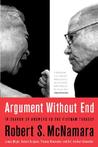
Argument Without End: In Search of Answers to the Vietnam TragedyArgument Without End: In Search of Answers to the Vietnam Tragedy by Robert S. McNamara
My rating: 2 of 5 stars

When In Retrospect first came out, some of the people at the college where I teach came up to me and said: "Did you hear? McNamara's published a book and he says the Viet Nam War was all a mistake!" Whoa - talk about your late-breaking news! Still, I suppose hearing those sentiments from the highest levels imparts a certain power to them that us lowly grunts could never hope to possess - but I think I recall saying "this is a big mistake" on my first patrol (I served in 'Nam in '68-'69).

The rub, of course, comes when we try to figure out WHY it was a mistake, and it is here that McNamara can give us something truly significant. That is his stated intent in this book. Does he? I think he does, but what he has to give us has been dished up many times before.

In preparation for this book, McNamara instituted a series of conferences between policy makers active during the "McNamara Years", from the U.S. and North Viet Nam. McNamara's stated goal is to search for "lost opportunities". Were there ways to avoid U.S. entanglement; or, having become entangled, were there ways for the U.S. to disengage before so many lives were lost? McNamara's idea here is to find those lost opportunities and lay them before the public.

So, it was with excitement that I read this book - maybe, finally, McNamara will come clean. And come clean he does, though not in the way he intended.

I knew I would have a different reaction to this book when I read how shocked McNamara was to learn the North Vietnamese side of the argument wanted to start in 1945 in the search for missed opportunities. McNamara's original intent was to limit discussion to the years 1961 - 1967; his years as Secretary of Defense. Here we have a sense of the man's over-arching ego; nothing important could have occurred before or after those dates. It is simply beyond my comprehension how the so-called "best and brightest" could be surprised at the date of 1945. For those of you who don't know, that's the date when the Vietnamese, under Ho Chi Minh, declared themselves independent of France, using words from the U.S. Declaration of Independence and the French Declaration on the Rights of Man. That is the date that Bao Dai, the last emperor of Viet Nam, formally abdicated his throne and anointed Ho Chi Minh as his successor. That is the date when Ho Chi Minh made direct appeals to President Truman to ensure the rights of the Vietnamese were respected. It is a date that is no secret now, and wasn't then.

How, then, could the chief architect of American policy towards Viet Nam be so awesomely ignorant of such an important starting point? The answer to that question is one of the lessons one might draw from the war: U.S. policy makers had no interest in Viet Nam per se. It was merely a stage, upon which the righteous Americans would meet and defeat the forces of "the Evil Empire". The McNamaras and the Rusks and the Rostows felt no need to learn anything about their potential adversary - to our ultimate sorrow. Know Thy Enemy. That lesson is nothing new; applied to this specific war, one can find it in Fire in the Lake, Frances FitzGerald's excellent work about the war published in 1971. What is new is McNamara's bald admission that he really had no interest in learning about the Vietnamese, nor did anyone else in the American administrations.

Another interesting part of the book is McNamara's complete lack of understanding at the refusal of the North Vietnamese to negotiate while we were bombing them. Despite the numerous lessons about the failure of strategic bombing to shorten wars and "force" the enemy to the negotiating table, America pursued the continued bombing of North Viet Nam in order to accomplish those self-same goals. All of this was known to McNamara and his cronies, and yet they allowed the strategic bombing of North Viet Nam to be one of the major foci of American policy. And now, thirty years after McNamara's involvement in the war, he still doesn't get it.

I wish to touch on just one more facet of Argument Without End. It includes a chapter by Col. Herbert Schandler and McNamara, entitled "U.S. Military Victory in Vietnam: A Dangerous Illusion?" Most of the chapter was written by Schandler, who did his time in 'Nam in the infantry. The answer to the rhetorical question posed in the title is, Yes - a U.S. military victory in Viet Nam is and was a dangerous illusion. I strongly agree with that answer, and I'm glad this chapter is in the book. But, dollars to doughnuts, this chapter won't shut up those deluded folks who think "we could've won if only the military had been allowed to win". This is because Schandler never really answers those critics who contend that the military had its hands tied in Viet Nam. This is too bad, because the answer is not all that difficult to comprehend. If the military had done exactly as it pleased in Viet Nam, we still would have lost. Without the support of the people we were supposed to help, there was no hope. Herein lies another lesson from the war: if we aren't true to our democratic principles in our foreign policy, our foreign policy will fail. We pontificate at great length about "self-determination", but we sure didn't allow it in Viet Nam.

In the end, these two books show Robert Strange McNamara to be not very bright - certainly not the best. They show a man steeped in his own arrogance, and that arrogance in him and those around him cost thousands of American lives and millions of Vietnamese lives. But give the man credit, he doesn't flinch from laying it all before us - even if he doesn't completely understand exactly what it is he's telling us.

View all my reviews

Friday, October 4, 2013

What is the role of government in our lives?

Well, we're starting the 4th day of the government shutdown with all the attendant finger-pointing. Personally, I park this particular monkey squarely on the back of the Tea Party republicans. I get that they don't "like" the Affordable Health Care Act (at least I get that they don't like it - why they don't like it is another matter), but to make funding the operations of the government dependent on de-funding the AHCA strikes me as bordering on disloyalty to the U.S. These are the actions of petulant children, not democratically elected "leaders".

Of course, Tea Party advocates would complain about the ever-encroaching reach of government, and there is some merit to such a view. The difficulty comes from trying to discern where the reach of government has gone too far, where it's just about right, and where it hasn't gone far enough. Tea Party folks take to heart a quote that they often wrongfully attribute to Thomas Jefferson: "That government is best which governs least." - a quote that actually owes it's genesis to an article in The United States Magazine and Democratic Review, and which appears in the form often used in Thoreau's Civil Disobedience. It's a thought which many find to be common sense, but in the modern world what does that mean?

What is the role of government in our lives? The most basic role is to defend our liberties, and for that we have the Armed Forces. But wait, defend our liberties (what are those) against what threats? The armed forces are particularly suited to defend our liberties against foreign powers, though one could argue that many times when the armed forces have been employed (at the direction of political leaders) they've been employed to advance the interests of a narrow sub-set of our society and not to protect our liberty. Having "done my part" during the Viet Nam war, I can state that the intent of protecting liberty is there in those that volunteer to serve, and the misuse of that intent is a crime for which they should not be blamed. Nonetheless, the armed forces are there to protect us against foreign threats, and they have done so.

The rub comes from other threats to our liberty. We have an environmental protection agency - is that there to protect our liberty? In my opinion - yes. Rampant pollution threatens not just our liberty, but our lives. We can see what happens when there is no regulation of industry in places such as China, and we've certainly seen it (and still see it) in our country. What about Health and Human Services? Again, when citizens lack access to adequate nutrition, where's their liberty? What about education? Perhaps the biggest threat to liberty is ignorance, and though I think the government has over-reached here (can you say No Child Left Behind?), it is vital for our continued existence to produce an educated public.

I could go on through the various government agencies, but you get the picture (I hope). We face a variety of threats to our liberty and our lives which we as individuals are not capable of addressing. Only the collective power of the government can defend us against those threats, and since we ARE the government, we can determine how much or how little we want government participation in that defense. But government can't do any of that if it's shut down - simply because some zealots don't like a particular act.